Journal

Author: Luong Tam

  • How the Tanuki 375 Began to Take Shape

    How the Tanuki 375 Began to Take Shape

    I felt good about my first rod. It was labeled Fatmonk 360—360 cm in length. The name Fat Monk symbolized something simple and joyful, which felt right for where I was in my journey.

    I took the rod to Utah, where I met Eric Ostrader of Tenkara Guides LLC in Salt Lake City. We headed up to Little Cottonwood Canyon, and in just one day on the river I learned a tremendous amount from Eric.

    About half an hour into fishing, Eric suddenly picked up his phone and called John Vetterli. John showed up roughly an hour later. The two of them spent a long time talking on the riverbank, then John took the rod and fished with it. He landed several fish—around six to eight inches—before returning to the bank. More discussion followed.

    The whole stretch of river was essentially mine.

    “Just keep fishing,” they told me.

    By the end of the day, we had become good friends.

    Before John headed out, both Eric and John said something that caught me off guard:

    “This is the rod. You should make more of these for the Tenkara community.”

    At first, we all wondered if it might simply be another “me-too” rod.

    “What’s a me-too rod?” I asked.

    Eric explained that when Tenkara was first introduced to the U.S. by Tenkara USA, many people jumped on the bandwagon—buying generic OEM rods from Alibaba, relabeling them, and selling them as their own. Those became known as me-too rods.

    That conversation stayed with me.

    From my background producing CD-ROM games, I already knew that making something for the market is difficult—but selling it is a hundred times harder. It takes time, energy, and a completely different mindset. I wasn’t ready to turn this into a business. I still saw it as a hobby—but I was willing to test the water.

    Eric also invited me to attend the first Oni Tenkara School that June. I was thrilled. It would be my first opportunity to meet the Japanese rod maker Masami Sakakibara—a living master whose influence on modern Tenkara is second to none.

    Around that time, I posted about my fishing experience with Eric on Facebook. We were nymphing—the weather was cold, there was no hatch, and at that point I was still transitioning from traditional fly fishing, where I mostly fished dries or nymphs rather than kebari.

    The response surprised me.

    A storm of comments followed:

    “Tenkara rods are not for nymphing.”

    “Tenkara is only for kebari.”

    I was confused.

    I kept asking myself a simple question:

    What does the rod have to do with it?

    To me, a rod is just a tool—an extension of the angler’s arm. The goal is simple: present a fly, connect with a fish, and enjoy the moment on the water.

    Still, fishing with kebari began to spark my curiosity. At the same time, I wondered what I was supposed to do with the thousands of flies I had tied over the past twenty years. Even so, I was happy to explore this almost mythical approach to fishing.

    After watching countless Tenkara videos online, one thing became clear: kebari demanded a softer, more responsive tip. Building a completely new rod would be expensive and would mean starting from scratch. Instead, I decided to experiment.

    I began by extending the first few tip sections of the rod. But changing length alone risked throwing the rod out of balance. The challenge was to keep the lower sections stable for casting and fish control, while allowing energy to flow through the rod smoothly.

    After many trials, the best solution I found was to extend the first three sections by about five centimeters each and subtly adjust the taper of sections four and five.

    I temporarily kept the original 360 label, covered it with Tanuki, and treated it as a prototype. The result was a 375 cm rod.

    I took the Tanuki 375 prototype to Oni Tenkara School to learn kebari fishing in the traditional Japanese style—and to receive feedback directly from Sakakibara-san and the community. It was the first time the rod was tested beyond my own hands.

    That experience became the turning point.

    The feedback I received—on the water and in conversation—was unexpectedly affirming. The rod had moved beyond experimentation and into something real. That moment marked the official birth of the Tanuki 375 and the beginning of the Tanuki rod journey.
  • How I Chose a Rod Maker and Built My First Tenkara Rod

    How I Chose a Rod Maker and Built My First Tenkara Rod

    From kitchen prototypes to the first finished rods

    After the prototypes were completed, my excitement quickly shifted to the next challenge: finding a rod maker who could help turn these experiments into real rods.

    Thanks to the internet, the entire world suddenly sat on my desktop.

    Unfortunately, none of the rod makers in the United States were interested in building a small run of prototypes. Some quoted prices that were simply out of reach. Others required long lead times—six months at minimum—along with large upfront deposits. At the same time, Japanese and Taiwanese rod builders weren’t interested in prototype work either. Many preferred to sell existing designs or tell me what they thought was best for me.

    I wasn’t looking to be sold a rod.

    I was looking for someone willing to build one with me.

    I searched through countless listings on platforms like Alibaba. Most factories wanted to push what they already had in stock. Others were unwilling to deviate from their standard designs.

    Then I found a small rod maker in China with a very different response.

    “Tell us what you want,” they said. “We’ll do our best.”

    That was all I needed to hear.

    I explained that I wanted to go through at least three rounds of prototypes, each built to my specifications. Their response was straightforward:

    “No problem—we’ll send you the PI options.” (PI stands for Purchase Invoice.)

    The standard turnaround time for a prototype was about four weeks. If I wanted it completed in less than two weeks, the cost would double. I chose speed—I couldn’t wait to see the first result. Even at double the cost, a two-week turnaround, combined with international shipping via FedEx, was still faster and more practical than any other option I had explored.

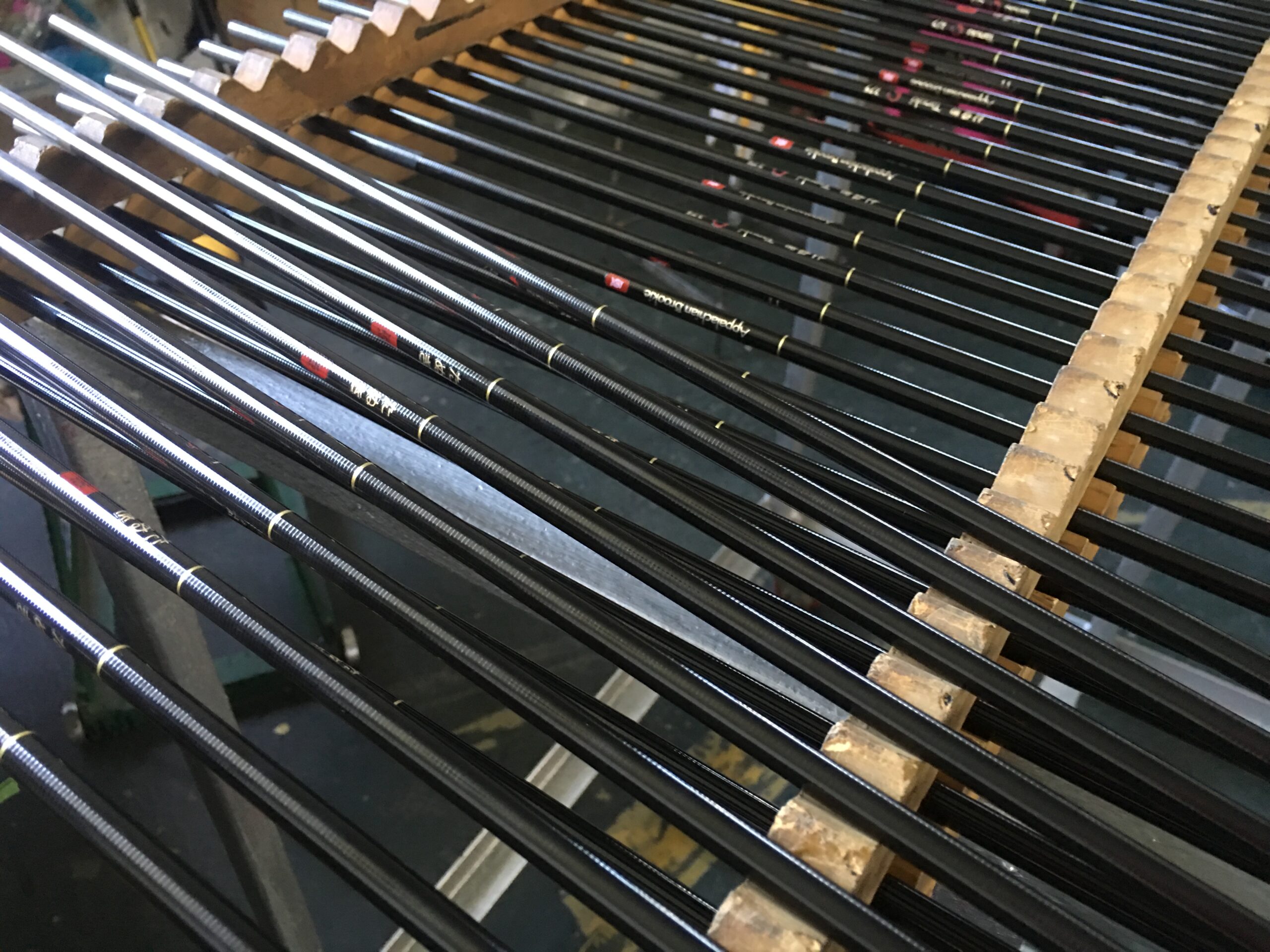
    The first batch arrived quickly: three prototype rods, each built with different materials. This allowed me to closely inspect carbon quality, construction consistency, and overall craftsmanship.

    After extensive casting-pond evaluation, I selected Toray 46T high-modulus carbon, approximately equivalent to what is commonly labeled IM12. Tonnage (T) refers to tensile modulus—higher values indicate stiffer fibers—but modulus alone does not define rod performance. IM ratings, by contrast, are manufacturer-defined and non-standardized.

    Compared to lower-modulus materials, Toray 46T offered reduced mass, faster recovery, and higher responsiveness. The trade-offs are increased material cost and a narrower flex envelope, both of which were acceptable within the intended design parameters.

    See the table below for an approximate Tonnage (T) to IM comparison.


    IM Rating vs. Tonnage — Approximate Equivalents

    IM RatingApproximate Tonnage Equivalent
    IM6~24T
    IM7~30T
    IM8~36T
    IM10~40T
    IM12~46T

    The second round of prototypes focused on improving flexibility and refining craftsmanship. I worked directly with the factory’s rod engineer, and to speed up the process we conducted strength tests and live rod-bend curve evaluations over Skype. This approach saved both time and shipping costs.

    By early February 2015, ten final rods were delivered with a simple label: Fatmonk 360 (360 cm). Ten rods were enough for me—to fish extensively and to gift to a few close fishing friends.

    fir

    I was thrilled.

    It was time to go fishing.

    Around that time, Hideto Ed Yoshida, president of the Tokyo Fly Fishing Club, flew over to visit. I took him fishing with the new rod.

    After a few casts, he turned to me and said,

    “This is the best Tenkara rod I’ve fished. Casting level line with your rod is hard to beat. It’s perfect for both nymphing and kebari.”

    I thanked him for the compliment, but part of me wondered if he was simply being polite. To be sure, I asked,

    “Do you think I should change anything if I commercialize the rod?”

    “No,” he replied. “Leave it alone. It’s perfect—for me.”

    That was when I knew his feedback was genuine.

    For the first time, I felt real confidence—not just in the rod, but in the journey that led to it. I couldn’t wait to put it into more hands and see what others felt.

  • Building My First Tenkara Rod

    Building My First Tenkara Rod

    From kitchen prototypes to the first finished rods

    After the prototypes were completed, my excitement quickly shifted to the next challenge: finding a rod maker who could help turn these experiments into real rods.

    Thanks to the internet, the entire world suddenly sat on my desktop.

    Unfortunately, none of the rod makers in the United States were interested in building a small run of prototypes. Some quoted prices that were simply out of reach. Others required long lead times—six months at minimum—along with large upfront deposits. At the same time, Japanese and Taiwanese rod builders weren’t interested in prototype work either. Many preferred to sell existing designs or tell me what they thought was best for me.

    I wasn’t looking to be sold a rod.

    I was looking for someone willing to build one with me.

    I searched through countless listings on platforms like Alibaba. Most factories wanted to push what they already had in stock. Others were unwilling to deviate from their standard designs.

    Then I found a small rod maker in China with a very different response.

    “Tell us what you want,” they said. “We’ll do our best.”

    That was all I needed to hear.

    I explained that I wanted to go through at least three rounds of prototypes, each built to my specifications. Their response was straightforward:

    “No problem—we’ll send you the PI options.” (PI stands for Purchase Invoice.)

    The standard turnaround time for a prototype was about four weeks. If I wanted it completed in less than two weeks, the cost would double. I chose speed—I couldn’t wait to see the first result. Even at double the cost, a two-week turnaround, combined with international shipping via FedEx, was still faster and more practical than any other option I had explored.

    The first batch arrived quickly: three prototype rods, each built with different materials. This allowed me to closely inspect carbon quality, construction consistency, and overall craftsmanship.

    After extensive handling and testing at the casting pond, I settled on Toray 46T high-density carbon, roughly equivalent to IM12. It was noticeably lighter and more responsive than lower-modulus options. The trade-off was higher cost and slightly reduced flex—but it aligned with my design goals.

    The second round of prototypes focused on improving flexibility and refining craftsmanship. I worked directly with the factory’s rod engineer, and to speed up the process we conducted strength tests and live rod-bend curve evaluations over Skype. This approach saved both time and shipping costs.

    By early February 2015, ten final rods were delivered with a simple label: Fatmonk 360 (360 cm). Ten rods were enough for me—to fish extensively and to gift to a few close fishing friends.

    I was thrilled.

  • Choosing My First Tenkara Rod — An Engineer’s Perspective

    Choosing My First Tenkara Rod — An Engineer’s Perspective

    After finally fishing with a Tenkara rod, I did what I always do when something truly captures my curiosity. As soon as I got home, I shut myself in a room and spent endless hours researching—reading, comparing, and trying to understand what actually made a Tenkara rod work.

    Choosing my first rod wasn’t easy. Nearly every rod I came across was well regarded and highly praised by Tenkara anglers. But I quickly noticed a pattern: most praise depended on who owned the rod. Everyone loved what they already had.

    Because rod building had been my hobby since I was nine years old—and because I had built my own split bamboo fly rods during the dot-com bust around 2000—I approached the search differently. I wasn’t looking for hype. I was looking at materials, construction, and taper. As both an engineer and a bamboo rod builder, taper mattered to me far more than brand names.

    At the same time, I kept my expectations grounded. A Tenkara rod cost about the same as two tanks of gas for a fishing trip. I decided to start simple.

    I bought a Dragontail rod for about $65. At the time, many people dismissed Tenkara as a fad, and I didn’t want to overcommit before I truly understood it.

    I quickly grew attached to that Dragontail rod. I fished it constantly, using it to prepare for the Tenkara Summit in September 2014, held in Boulder and hosted by Tenkara USA.

    That trip changed everything.

    At the summit, I learned directly from Dr. Hisao Ishigaki, a Japanese Tenkara master. Watching him manipulate the fly and control the drift opened my eyes—not just to Tenkara, but to fly fishing as a whole. It was the simplest form of fly fishing I had ever seen, yet also the most intentional.

    By the end of the summit, my thinking had shifted. I wanted the longest rod Tenkara USA offered—but it was sold out. I was told to order it online.

    On the drive back to California, I was completely energized. I stopped whenever I saw water along the roadside and practiced the fly-manipulation techniques I had just learned. By the time I got home, I felt ready to step up.

    After more research, I found myself on the website of Tenkara no Oni—which roughly translates to “The Devil of Tenkara.” I purchased what I considered the most beautiful rod I had ever seen: a 13-foot Oni Type I with a bamboo handle, for about $400 including accessories.

    The Oni rod was remarkable. Although it was longer than the Dragontail, it felt lighter, better balanced, and significantly easier to cast. From the first few casts, it felt as if the rod had been made specifically for me.

    I couldn’t wait to test it properly, so I loaded the car and took a short trip to Baum Lake in California. Baum Lake is famous for steady fish activity on cloudy autumn days, when trout rise consistently for midges. With its slow-moving water, it’s an ideal place for dead-drift presentations.

    On a good day, landing 30 to 50 fish is normal there; landing more than 100 is not uncommon.

    My first day with the Oni rod was humbling. I broke off five fish out of ten and landed only three out of five solid hookups. But within a few hours, something clicked. My hook-up rate improved, and landing fish became more controlled and deliberate.

    Fishing both the Dragontail and the Oni made me aware of what each offered me on the water. The Dragontail gave me confidence when controlling fish, especially in fast current. The Oni felt effortless in casting—light, balanced, beautifully crafted, and deeply connected to the fish.

    Over time, I found myself wishing there were a rod that combined what I valued in both. Most of the trout I catch are wild fish in high-mountain Sierra streams, where a 12-inch trout is a trophy and strong current is the norm. But in some waters near larger lakes—like the Upper Owens River, Robinson Creek, and the East Walker River—20-inch fish are not uncommon.

    In those conditions, I wanted the lightness, casting fluidity, and sensitivity of the Oni, paired with the control and confidence the Dragontail gave me in fast water. Maybe I was asking too much—but I wanted a rod that treated a 10-inch fish in the Owens Gorge like a trophy, while still offering the control to handle a 22-inch fish when it mattered.

    For me, choosing the rod mattered deeply. Rod making is my craft. A good Tenkara rod costs only a fraction of a fly rod, yet its impact on feel and performance is enormous. For a serious angler, choosing the right Tenkara rod is not trivial—it shapes the entire experience.